Showing posts with label Mental health. Show all posts

Saturday, 20 February 2016

My Baby, Psychosis and Me

Like many others involved in the campaign to raise awareness of, and improve services for, postpartum psychosis and other perinatal mental illnesses - I tuned in to BBC One's "My Baby, Psychosis and Me" earlier this week.  The documentary was aired as part of the BBC's #InTheMind season, and achieved both impressive viewing figures (for being on so late) and astonishing viewer reactions.  I gathered just a selection of the Twitter response to the programme in this Storify:
https://storify.com/katgrant30/my-baby-psychosis-and-me 
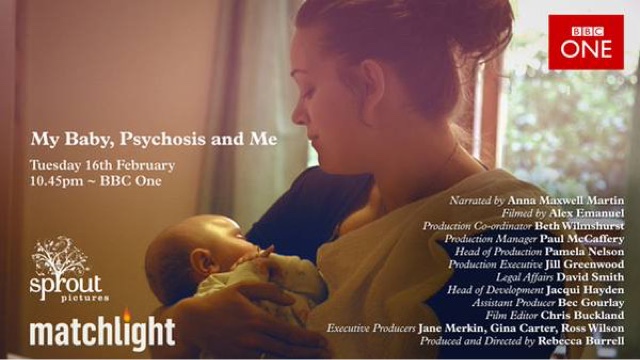


A few days later, I wish to record some of my own thoughts on it all.  Before I begin I declare the following interests (baggage?):
1) I am a huge fan of Dr Alain Gregoire (the consultant in charge of the Winchester MBU, where the documentary was filmed) and his whole team.
2) Like the two women featured, Hannah and Jenny, I survived PP through being hospitalised for a significant length of time and medicated using powerful antipsychotic drugs.  I am hugely grateful to Psychiatry and the allied professions.

Ok, with that out of the way, let's begin our analysis...

We are introduced to Hannah and Jenny with no pleasantries.  They are both acutely unwell and in desperate need of a Mother and Baby Unit bed.  There were rumblings from some quarters of the audience about not knowing enough of the women's backgrounds, their history, their psychology.  But I think the filmmaker's approach in this case was to mirror reality: in a psychiatric emergency there is no opportunity for lengthy introductions or even so much as a how-do-you-do.  I liked the way the women came into the film: at the start they were their illness.  The psychosis in each case had largely consumed them, and it was the job of Dr Gregoire to find them again.

At times the film was almost unbearably sad.  It was during those times I, personally, retreated to the relative safety of Twitter and took a "social media management" approach to viewing the show.  My husband (who was in London, while I was visiting my family in Scotland) texted me to say how he thought I was "more of a Hannah psychosis than a Jenny psychosis".  I think he may be right.  I found Jenny's illness fascinating (the links to her bipolar, the ebb and flow of her mania, her paranoia)... But it was in Hannah that I really recognised myself: the sheer desperation, the terror, the restlessness, the crippling anxiety and self-doubt.  Watching Hannah in this state made me want to reach into my television and hold her tight and whisper intently into her ear: you will be ok.  You will get out of here.  You are a brilliant mum.  Hold on.  Hold on.  Hold on.

One thing the cameras didn't quite manage to convey (and perhaps this was deliberate) were the actual hallucinations.  Seeing things that are not there, hearing voices, experiencing the world completely differently from those around you, that is the nub of psychosis and the truly petrifying element of the disease.  I can only imagine that in those moments the cameraman was perhaps shepherded away.   In my own case, when I was "floridly psychotic" (how I love that term!), the other patients and any visitors to the ward would be ushered away to the safety of the communal nursery where the heavy door would clunk shut and a member of staff be on guard until it was safe for them all to come back out.

The cameras didn't capture these moments, but I'm sure they were experienced by Jenny and Hannah nonetheless.  And allowing a film crew to capture even just the recovery from this absolute Hell is a testament to their strength and courage.  We viewers were privileged to see ward round discussions (an absolute insight to the staff's continual balancing act of risk and recovery), the side effects and treatment effects of various medications, and even Hannah's experience of Electro-Convulsive Therapy (ECT).

I had seen ECT before but only in movies (remember Requiem For A Dream?).  Seeing it performed on Hannah "in real life" was gut wrenching and shocking.  But it worked.  And I kept thinking only how brave and determined she was: willing to try anything in order to just get better and be there for her daughter.  She wanted to die so much - and yet she desperately wanted her daughter to grow up with a mummy.  It was true incredible to watch.  And it seemed to work!

There have been a few comments online about how medicalised the programme was, with its focus on medication and ECT.  Yes, there was a lot of psychiatry on show.  But, again, I think this is realistic: postpartum psychosis is a psychiatric emergency.  There is a huge amount for psychology and other types of complementing therapy to do - but only after the PP is under control.  I personally would have loved a second part of the documentary, which went on to show the role of clinical psychologists, psychotherapists, family therapists, peer supporters, art therapists, occupational therapists and so on. But there was only an hour and given this was a documentary about the experience of PP it seems right that the focus was on psychiatry.  And what a psychiatrist!  I think even the most skeptical anti-psychiatry voices were won over by Dr Gregoire.
He explains his considered thoughts on mental illness and the brain so eloquently.  If even just a tenth of Dr Gregoire's compassion and understanding could be captured and inserted into every single health care professional we would go a long way to treating mental illness properly.  To achieving that "parity of esteem" our current government loves to speak about.

And I wish everyone could listen to Jenny's husband Henry as he speaks of his wife - how funny, how kind, how caring she is.  All of which is at first hidden by her illness.  I think Dr Gregoire and his staff "get it".

I was lucky to have just spent a day at the Winchester MBU where I witnessed first-hand how therapeutic the whole environment is.  Without compromising safety (always a huge priority in any acute mental illness ward) the staff are all trained and guided to be therapeutic at all times.  Every interaction is an opportunity for them, from taking a patient for a walk to the shops to helping them with baby's sleep routine at night.  The patients are encouraged to cook meals together (with the help of their very popular young Occupational Therapist), to take part in gardening projects, to do lots of messy play and crafting activities (with and without the babies).  None of this was captured in the documentary - it wasn't the focus - but I do wish to reassure any viewers who might be left with the impression that all the patients were treated with were pharmaceuticals.

I will leave it at that.  I'm off to watch it again on iplayer (still available here: http://www.bbc.co.uk/iplayer/group/p03hybyj ).  I want to watch it alone, with my smartphone switched off, and just let it all sink in properly.  

Sunday, 31 January 2016

Balance sheet brain

My friend and mental health colleague has written this insightful and heart-breakingly honest blog about her bipolar disorder: 

It is a fantastic read, and has inspired me to write down a few of my own thoughts on bipolar, and how it has shaped me.  I was only diagnosed with bipolar in 2013 (following an episode of postpartum psychosis), but I believe it has been with me throughout my adult life.  To be perfectly honest, for most of the time, I give it very little thought.  Why should I be defined by a diagnosis?  I'm a person (a very flawed and imperfect one!) and not a collection of symptoms listed in the DSM.

But, from time to time, I have to accept that bipolar becomes me.  Think of it like a child's see-saw: for much of the time the see-saw gently bounces up and down, the forces acting upon it are balanced and benign.  Gentle ups followed by gentle downs.  And quite a lot of time spent barely bouncing at all.  Bipolar becomes me when the control of the bounce has gone: the see-saw swings wildly from ground to sky and those once-happy tots are in grave danger of bouncing straight out of their seats.

Another useful analogy is the accountant's balance sheet.  Assets and liabilities.  

"Fixed assets" are those elements of my brain which are basically permanent: my genetic inheritance, the nurturing childhood I enjoyed, the relationship with my son and husband, the positive elements of my basic personality.

Conversely, "long term liabilities" are a constant balancing force on the other side of the equation: my innate selfishness, my notorious short fuse, the long-lasting after effects of psychosis and mental breakdown.

Heavy stuff.

But the more interesting aspect of the balance sheet analogy is the current assets and liabilities: those things coming in and out of my life, impacting my emotions and feelings and behaviours in an immediate (and usually temporary) way.  In a person who doesn't have bipolar disorder, these ebbs and flows tend not to have too many untoward effects.  But for a person with bipolar, they can have profound consequences.  

On the "asset" side:
- financial overconfidence
- workplace arrogance
- lowered inhibitions
- impulsiveness 
- thrill seeking.

All things which feel wonderful at the time (hence landing on the asset side) but which can quickly become "hypomania" and perhaps even mania or psychosis.  I have a long list of people to whom I really ought to make amends: old friends, ex boyfriends, work colleagues, former managers, family.  (I don't include the credit card companies which must have made a small fortune from the constant high-interest debt I serviced for over ten years).

On the liabilities side:
- Low self worth and self esteem 
- Anxiety
- Sadness
- Paranoia.

These are all the R easons why bipolar disorder is a "disorder" and not some Limitless-style magical way of being.  Feeling sad, low, unworthy, are all normal human emotions.  But in bipolar disorder it seems that the thought processes going along with it are an extreme: catastrophic, overwhelming, fearful. 

The cumulative effects of all these current "assets and liabilities" then become the long-term and fixed aspects of me.

I won't ever not have bipolar disorder.  I will always have this balance sheet brain. 

But I can certainly learn how to manage it, how to account for it, and (apologies for stretching this tenuous analogy to the very limit) be my own book-keeper.

Happy "Time To Talk" day!

Thursday, 14 January 2016

It shouldn't have to be this hard...

... But it is.

Today I (along with my wonderful friend and fellow campaigner Eve Canavan) gave another television interview, about perinatal mental health services.  The topic is of great interest currently, with the EastEnders storyline and all the associated coverage.  The team from BBC Breakfast, putting together a segment for Tuesday 19 January edition, were interested to know how women like Stacey may be treated, and what barriers to treatment they might face.  We spoke to the journalist at length about what had happened to us, and what we would like to see happen in the future.

Eve's story is particularly shocking.  You can read it here: https://smalltimemum1.wordpress.com/2015/11/22/i-need-a-bed-of-strawberry-creams-in-a-place-of-recovery-dreams/ .

As I spoke, it all came tumbling out.  I'm afraid I may have been rambling and not a little emotional.  But, you see, it's hard to remain dispassionate when we are talking about people's lives.  Babies growing up with poorly parents and (completely treatable) illnesses worsening and lingering.

Politicians love to talk about Parity of Esteem for mental health (in relation to physical).  There was great fanfare this week (on Monday 11 January) when David Cameron announced a near £1 billion funding boost for mental health services.  But already, we know this isn't enough to reverse the years of underfunding.  Speaking starkly: you have to literally be at death's door to access real care for your mental illness.

Have you tried to take your life?
Have you made any detailed suicide plans, such as stockpiling medication?
Are you a danger to others?

No?

Well, I'm sorry, but please get back in the line.

You don't meet our thresholds.
You aren't in immediate danger.
You can cope at home with your family.
There are people a lot sicker than you, you know.

This is a familiar story for anyone suffering with a severe mental illness.  For children and young people the thresholds are even higher.  Mums are (generally) quite fortunate: perinatal mental illness is becoming more recognised.  But even in this field, huge gaps remain.  The Maternal Mental Health Alliance "map" of service provision illustrates the problem: 

Getting help is just too hard, for too long, for too many.

It shouldn't have to be this hard.

But it is.

In a previous life, I used to be a health economist.  I once worked on a project for the Department of Health, looking at the cost of long term conditions such as diabetes, heart disease, and mental illness. It was clear from that research that mental illness was a huge burden to both the NHS and society (as well of course completely debilitating for the families concerned).  The research I looked at showed that just small investments in tackling mental illness - at the earliest opportunity - could lead to massive gains and cost savings further down the line.

It is a no-brainer.


In other branches of medicine, it is completely accepted that the earlier you identify and start treating a condition, the better.  
Lump in your breast?  Referral for mammograms and if there is any doubt, proceed with appropriate treatment.
Nasty chest infection?  Course of antibiotics, to prevent it developing into full-blown pneumonia.
Had a minor stroke?  Start a course of preventative medication to avert future crises.
Broken leg?  Immediate fix, and physiotherapy to get you back on your feet.

In none of these cases would a doctor employ "watchful waiting".  But in presentations of mental illness, this is precisely what they do.
Depressed?  Well you're not actively suicidal so there isn't really anything we can do.  Here's some advice to exercise more and get some fresh air.

I have been busy in the world of mental health campaigning for almost three years now, and this seems to me to be the biggest recurring problem: access, recognition, identification and treatment.  Just how bad does a new mum (for example) have to feel, before being given access to specialist help and support?  I have heard too many stories of closed doors and families living on the edge, trying their best to keep their loved ones safe.

It shouldn't have to be this hard.

Sunday, 10 January 2016

£290 million

This morning, David Cameron announced a huge injection of cash into mental health services. (http://bbc.in/1RvwrDg)

Included in a package of almost £1 billion is a sizeable £290 million (spent over the next four years) to provide specialist care to mums before and after having their babies.

This money is welcome, it is significant, and it could make a real difference to the 1 in 5 mums who suffer mental ill health during the perinatal period.  However.  Government hasn't got a great track record when it comes to protecting mental health services and in fact seem to have done their best to belittle and diminish what patchy care there is.  

But let's let bygones be bygones.  Here's a real chance to get it right. If they were to ask me, where would I tell them to spend it?

1. Perinatal mental health midwives in every maternity service.
This is the first decision I would make: to recruit, train and commission enough specialist posts to cover the entirety of the UK's maternity system.  These midwives would have time to care for the most at-risk, distressed and struggling pregnant women and new mums.  They would provide special antenatal and postnatal classes to women in their care, as well as being a continuous point of contact in each mum's care pathway.  They would also be a first point of call for psychiatric emergencies in the pre and postnatal period. 

2. Mandatory perinatal mental illness module included in all midwifery, health visiting and general practice training schemes.
All healthcare professionals likely to be in contact with pregnant and postnatal women will have undergone a minimum training in perinatal mental health.  The aims of the training are to increase awareness of different mental illnesses, how to signpost to the correct sources of support, and how to provide immediate support and reassurance. 

3. Mother and Baby Units in every region of the UK.
At last, here is a chance to close the gaps and end the postcode lottery of perinatal mental health services.  Let's stop closing down MBUs (unit numbers have fallen from 22 to just 16 in recent years, with more under threat).  Let's protect and nurture those units we have. And let's open much needed new MBU beds in regions such as the South West, Wales and Northern Ireland.

4. Enhanced therapeutic programme for all perinatal services (inpatient and community).
This is the ultimate "Nice To Have" in perinatal mental health care.  Psychiatrists are a wonderful breed who can do remarkable things with illnesses of the brain.  But they aren't miracle workers.  Recovery from severe mental illness, or living well with an enduring mental illness, takes guts.  It takes tenacity, ingenuity, creativity.  Everything and anything should be considered, depending of course on the individual. I would like to see a non-neglible portion of funds set aside for grant-making programmes for local sources of support:  walking groups and buggy fitness for mums and dads, group mindfulness therapy, art and drama therapy, parent-infant therapy, and (especially) high quality peer support.

Thursday, 7 January 2016

Meanwhile, in another Dimension...

*** This essay was inspired by a similar piece written by Bipolar Blogger last year, and available to read here: https://purplepersuasion.wordpress.com/2014/03/19/a-mental-health-fairy-tale/ ***

Imagine a world where the government in power is committed to the long term future of the NHS.  The energetic MP Luciana Berger enjoys a cabinet-level post with a brief to drastically improve mental healthcare, and ensure that every family gets the health and social care services they need.  The Government has acknowledged the LSE report (http://everyonesbusiness.org.uk/wp-content/uploads/2014/12/Embargoed-20th-Oct-Summary-of-Economic-Report-costs-of-Perinatal-Mental-Health-problems.pdf) which found that undertreated mental illness amongst new parents costs the UK economy over £8 billion every year.  And furthermore, the Government has fully signed up to the 1001 Critical Days campaign, calling for the best start in life for every child, to grow up in households free from the debilitating trauma of untreated mental illness.

Into this world, a baby is born.  Jacob was much anticipated and planned for, the son of a young couple, John and Susan, with no history of mental illness.  His birth was traumatic, and shortly afterward Susan was behaving erratically.  Her family became worried.  They consulted the pack given to every new parent upon leaving the maternity ward: in it, was a plain-speaking leaflet on perinatal mental illness, and a list of local resources.  They called the local number and a specially trained midwife answered the phone.

The midwife Maya asked John a few questions, before arranging a home visit.  By the time she came over, later that afternoon, Susan was delirious.  Maya explained that Susan may be suffering from a condition called postpartum psychosis, and needed to be seen by a perinatal psychiatrist straight away.  She advised John to pack an overnight kit for both Susan and baby Jacob, as most often a spell in hospital was necessary.  She reassured him: don't worry, this is very treatable, with the right help Susan will be recovered very soon.

In this Dimension, Mother and Baby Units are the standard way of treating severe perinatal mental illness in the UK.  The Government had invested enough money to ensure that there was an MBU in every region of the UK - including Wales, Northern Ireland, the South West and Highlands and Islands.  This couple were fortunate: their local MBU was just a ten minute drive away.  It had an international reputation for the quality of its care.

Maya patiently explained what would happen next.  They would all drive over to the MBU, for assessment by the psychiatrist.  They would likely be admitted, as a bed was available.  John was very nervous, but he felt reassured by the midwife's kind words, and the written information she gave him to digest later.

They rang the bell of the MBU: from the outside, it looked like a slightly-larger-than-average family home.  It had colourful paintwork and a well-stocked garden.  Other than the double-locked entranceway, there was little indication that this was an acute psychiatric facility. They were greeted by a staff nurse, who showed them into a comfortable sitting room.  Susan, by this stage increasingly agitated, was encouraged to sit in a nursing chair and she used the pillows to prop herself up and continue breastfeeding while the doctor came in.

"I'm Dr Brown.  But please call me Matthew."
Matthew shaked their hands and sat next to the mum.  
"From what I have seen so far, it looks like you may be suffering from postpartum psychosis.  But Susan, please don't worry: you will get better here.  And you and Jacob can stay here as long as you like until you are better."

"Here comes nurse Sarah, to give you the tour and help you settle in".

The young nurse Sarah took Susan by the hand, and showed her around the Unit.  

"You've already seen the sitting room, where we tend to hang out in the evenings.  Quite often the mums like a nice "adult" space away from all the baby stuff.  Here we can stick the telly on, or listen to music.  We've got a great DVD stash. 

"And just down here is the nursery.  We've got everything you might want for Jacob: toys, books, playmats, bouncers.  Don't worry if you've forgotten anything - we've had a lot of donations from former residents over the years, we can always find clothes to fit or toys you are looking for.  Here are the nursing chairs, and you see our resident Yolanda over there? She's using one of our hospital-grade breast pumps.  Our breastfeeding counsellor comes in every day, and she can show you how to use it if you like?

"We've also got the baby sleep zone: you'll see some of the babies sleep in there, so their mums can get a full nights rest.  It's all monitored and of course if Jacob is in there you can pop in and check on him whenever you like."

Sarah opened various brightly painted doors: to the baby changing station, the milk storage room, and the resident's kitchenette (with tea and coffee maker, toaster and microwave).  There was a beautiful dining area with French doors out to the garden.  On the large oak table was a big bowl of fruit, and pots of jam one of the mums had made in the OT cooking class.  Some of the residents were sat outside on the patio chairs, drinking tea.  Their babies were rolling around on picnic blankets.

"We have ten bedrooms here, and you'll soon get to know everyone.  The mums out there are Kate and Daphne - they are both due to go home soon, but not that long ago they were both very poorly themselves.  I've checked and they are both very happy to chat about their experiences, and what helped in their recoveries.  We find peer support here to be invaluable, and we also encourage everyone to attend group therapy sessions and to log in to the online Twitter support group every week.

Here is your room.  I'm sorry it's on the small side, but we used the space to make sure all the rooms had en suite bathrooms.  We really value our residents privacy, and ability to relax, here.  We do have to make regular observations, but we will explain the procedures carefully so that you understand what and why we are doing certain things.  I know a psychiatric hospital is a scary place to be, but I promise we will try to allow you to feel at ease."

Sarah continued the tour, by showing Susan and John the nurses station and notice board.

"This is the real hub of the MBU, right here.  I know it looks confusing, but here on this big board is everything you might want to know: who is on duty, their names and job descriptions, who is your named nurse, when the doctor is next available.  You'll also see all our different timetables: we have one for relaxation and mindfulness activities, one for the group exercise programme run over in the OT gym especially for new mums, and one for the mum and baby activities.  Right now, we have Rhyme Time, baby massage, postnatal yoga, and Monkey Music.  We encourage the Dads to join in with these too, so some of the classes take place at the weekend.   Talking about dads, we believe in the whole-family approach here.  Two of our bedrooms are actually self-contained family units, which might be suitable for the three of you once you are feeling a little better.  You're a family now, and we treat you as a family!

"So, back to the timetables.  We try to encourage our residents to pick just one or two activities, to fit around their regular psychology and psychiatry appointments.  As you start to feel better, you might want to do more - and perhaps explore all the other activities put on by the OT department and patient-led groups.

"I can see this is all a bit overwhelming!  Don't worry, you don't have to sign up to anything just yet.  And all the information is also in your welcome folder, just there by your bed.

"The first step is to start getting you better.  John told the doctor that you haven't really slept since Jacob was born? Ok, so this is the priority for tonight.  Will it be ok with you to take Jacob to the nursery, so you can have a lovely bath and an early night?"

Susan nodded.  As John took Jacob down to the nursery, she felt a wave of relief.  She sank down onto the comfy bed as nurse Sarah drew the bath and added a liberal handful of lavender bath salts.  She felt safe, for the first time since Jacob was born.  She knew she was in the right place.


Sunday, 27 December 2015

What is postpartum psychosis?

Regular viewers of Eastenders are full of questions right now.  Does Stacey have PND? Who is the dad, if it's not Martin or Kush? Why is she acting so strangely?

The Eastenders team have already revealed that Stacey is in fact suffering from a rare birth complication called Postpartum Psychosis (PP), which sadly is not all that unusual in women with bipolar disorder (such as poor Stacey).

As someone who has been through it, and come out the other side, I thought I'd gather some thoughts together on the subject.

This is not a dream
Hallucinations (auditory and visual) aren't like having a bad dream or being a bit trippy.  There aren't any blurred edges or ghost-like figures or spooky whispers in the dark.  Hallucinations were as real as the world around me today: I could see, hear, touch, people who I experienced as completely there.  I remember the situations now, just as I remember what I had for dinner last night.  I reacted to them as if they were happening to me, right there and then.

This is not a joke
I guess it is possible to have a "benign" or even quite pleasant psychosis.  That's not my experience, but it must technically be possible.  But psychosis seems to be rooted in trauma and distress.  So it manifests itself as brutally and as nastily as the innermost reaches of the brain can conjure up.  Unfortunately for me (someone who devoured horror novels as a teenager) my brain could conjure up plenty of darkness and depravity.  Worst fears, tortures, humiliations - they were all brought to the surface by psychosis.

This is it.
I fought the psychosis like a woman possessed - because that's what I was.  I wasn't going to take it lying down: being suffocated, burnt alive, alone forever, dragged to hell.  I fought it.  Because I had to. It isn't the psychosis itself that is dangerous (after all, it is all in the head) but it is the real, physical, reaction to it.  The natural human instinct to run, fight, escape.  Psychotic people have jumped from buildings, thrown themselves onto roads, lashed out at others, become so mentally distressed they make themselves physically sick.  This is why PP must be treated as an emergency, with intensive inpatient treatment (ideally in a specialist Mother and Baby Unit).

I was very lucky to have been admitted to the MBU relatively quickly, where I was safe from the physical effects of the illness.  The psychosis could run its course under careful clinical supervision, and there was absolutely no risk to my baby (who was being expertly cared for in the ward nursery).

I won't give any spoilers for Eastenders fans, but viewers will need to brace themselves: Stacey's journey will be raw and real and incredibly moving.

For lots more information (as well as support) please see Action on Postpartum Psychosis: www.app-network.org 

Wednesday, 23 December 2015

Ghosts of Christmas Past

With less than 48 hours to go, Christmas 2015 is looking like my first properly mental-illness-free festive period in my adult life. 
*Touch Wood*

I don't know if this counts as seasonal affective disorder, but for whatever reason my mood never fails to dip towards the end of autumn, just in time for full-blown depression for December 25th.  Merry Christmas!

Ways I have spent Christmases past: 
- in tears 
- in debt (having overspent on credit cards on loved ones' presents, to make up for my horrendous moods)
- in a state of numbness 
- in a mess (unable to summon the enthusiasm to wear something festive, or blow dry my hair, on slap on some make-up).

December 2012 shook all that up: I was on home leave from psychiatric hospital, my eight week old son in tow.  I was just grateful to be alive, to be lucid, to be a person in the world, to not be in hell any more.  Those few hours spent at home cemented in me what was important: health and happiness. Family and friends. Sanity.  Nothing else mattered.  Not the presents I bought, the clothes I wore, the smiles I offered. 

The following year, we relished the chance to be properly together, just the three of us.  It was low-key, but special.  I was still somewhat fragile, but on an even keel.  We got a tree, we cooked a big roast with all the trimmings, we lovingly prepared a stocking for The Boy.

The year after that, I was recovering from a spell of acute anxiety.  I had taken on perhaps one or two too many commitments over the summer and early autumn, which led to one or two restless nights, which led to a real fear of becoming psychotic again. This "relapse" shook me to my core, and I spent Christmas 2014 still reeling from it.

But this year - 2015 - I can honestly appraise myself as being OK.  I've been busy, for sure, but with The Boy now at nursery I finally have some regular "Me time".  I can tell very quickly when I'm becoming a bit over-anxious, or irritable, hypomanic, or down.  I have the tools (some of which learnt on Mental Health First Aid, some just through experience) to self-correct and stay on track.

So, this Christmas, I will be raising a glass to Good Health and giving thanks for what has been by all accounts a great year.  I'm grateful for every day of good health I have.  But with a super-excited three year old in the house, I am especially grateful for a happy and healthy Christmas day.

❄️ Merry Christmas! ❄️

Tuesday, 17 November 2015

Working the room


I couldn't let yesterday go by without jotting down some thoughts.  16 November 2015 has got to go down as one of the more eventful days in my adult life!

It started with a 9am deadline, to submit a tender for a small piece of consultancy work for a large mental health charity.  This work (if I am lucky enough to get it!) would be a fantastic start to my fledgling business, Out Of My Mind.  I didn't have long to respond to the Invitation To Tender, but I was relatively happy with what I managed to produce over the weekend (mainly because I persuaded an amazing lady with fabulous credentials to partner with me on the bid!).

The day then continued with a visit to the illustrious Royal College of Psychiatrists for their perinatal annual forum.  I was hosting a workshop on peer support and third sector services in perinatal mental health, alongside my patient representative colleague Cath Beard.  Cath was instrumental in setting up the Friends of the Birmingham MBU, as well as volunteering with MaternalOCD.

The whole day was really interesting, with a brilliant keynote speech from Heather O'Mahen of Exeter University (on adapting IAPT for perinatal women) and a lively debate on the merits of extending perinatal services to families of children up to age 5.  Our peer support workshop was incredibly well attended, and the audience (of perinatal psychiatrists, psychologists and other health professionals) seemed really engaged with what Cath and I were presenting.


Anyone who has read this blog recently will know how passionate I have become about good quality peer support.  I hope we managed to convey both the amazing opportunities and potential risks of these services.  The feedback we got afterwards certainly seemed to suggest so.

After a quick glass of wine and a catch up with my favourite team from the Bethlem, it was home in an Uber to quickly change into my glad rags for the Mind Media Awards.  My beautiful friend Eve and I had been invited by the Mind Media team, as we are both currently working with them on a TOP SECRET popular TV show (watch this space, around Christmas time).  After some agonising over what to wear I was soon dolled up in my floor-length metallic gold dress, with full make-up (a rarity for me) and full Spanx for good measure.

Eve and I arrived at The Troxy (a spectacular Art Deco theatre in East London) to find the place already crammed with media types quaffing the free booze.  Help, we didn't know anyone!  How does one schmooze at this sort of event?!?

I quickly spotted the talented Victoria McDonald - health correspondent for Channel Four News, one of the award judges, and a shortlisted nominee herself for work including an interview with yours truly last year!  She was happy to chat for a while and I soon relaxed.  


Before taking our seats for the ceremony, Eve and I had a chance to promote the #PNDFamily cause in the photo booth:
I have never been so pleased with a photo of myself before!

The ceremony was hosted by former psychiatric nurse and now national institution herself, Jo Brand.  She gave us some hilarious anecdotes from her time on a psychiatric emergency ward, dealing with over-zealous police recruits and tyrannical matrons.  There was also many serious messages in her introduction: about the "theme" of the evening (suicide) and how there is still plenty work to be done to remove the stigma of mental illness.

The winners, and to be fair all the shortlisted nominees, were all inspirational: putting out difficult messages, tackling taboo subjects, smashing stigma and speaking out.  I was delighted to see 24 Hours in A&E pick up a prize, as well as Victoria in the current affairs category (she was even kind enough to give me a wee shout out from the stage!).  

Nothing could beat the final award of the night however: a special "Making A Difference" award to Jonny Benjamin and his "Mike", Neil Laybourn.  Jonny and Neil spoke so brilliantly about what happened on Waterloo Bridge seven years ago, and how their lives have changed since.  I am so grateful to Neil for stopping Jonny jump that day, and for everything he continues to do to raise awareness and get people talking.  And Jonny.  Well Jonny is just my hero.  One of the nicest guys I've ever met, and so generous with his time and his heart.  ❤️

The rest of the night was just a warm fuzzy blur of free-flowing wine, not much food, and ensnaring any vaguely famous or well-connected person in Eve and I's vicelike perinatal pincer grip.  Here are just a few of the people we met, and talked to about postpartum psychosis and maternal mental health:
Myself, Dr Ranj from CBeebies, and Eve
Myself and David Robb aka Dr Clarkson from Downton Abbey!!

Myself, the beautiful Frankie Bridge, and the equally gorgeous Eve.

I really hope all this great work, and the amazing connections made at the event, continues into 2016.  Well done to Mind Charity and especially their fantastic media team for all their hard work in 2015.

Wednesday, 28 October 2015

Peer support: How to make it Effective, Safe and FUN.

From very early on in my recovery from postpartum psychosis, I felt a strong compulsion to try and help others.  Not only by sharing my story openly and honestly, but also by sharing the lessons of experience.  I knew that such support would have helped me enormously in the dark days of psychiatric care, depression and overwhelming anxiety.

But where to begin?

I'd spent my pre-psychosis life as an economist and management consultant.  I was used to solving problems, yes, but had no experience of caring for or supporting others.  I wasn't a "people person".  

My first foray into the world of peer support was not a great success.  I was seduced by a charity's promise of instant support group set-up, advertising material and name recognition.  My group was hence born overnight.  I received a large (and no doubt expensive) pack of promotional posters and pamphlets and proceeded to call in to all the GP surgeries in the local area.  I excitedly booked a community hall for my first meeting, and went about baking cakes and purchasing coffee supplies.  What more need I have done?

Within a few short weeks it was hopelessly apparent that much, much, more needed to be in place.

Simple things, like my criminal record check, had not been verified.

I had received no training, or even basic guidance.

There was no oversight in place.

Women - often very vulnerable women - were being referred to me through the charity's website, with no inkling that I was completely unprepared and unsupported to help them. 

I had received no training or advice in children's and vulnerable adults' safeguarding.  Or in how to enforce healthy boundaries between my role as peer supporter and the rest of my life.

There were other concerns too, but these were the glaring ones.

Luckily, a month or two later, I came to meet an inspirational peer supporter and charity founder Jessica Warne.  Jessica was a few years' ahead of me in terms of her own recovery and journey as a peer supporter.  What had started as a simple coffee morning in her own front room had transformed into a registered charity, with a committed and experienced board of trustees, good working relationships with other local organisations, and a clear programme of peer and professional support.

Jessica and I met over coffee near Oxford Circus (our halfway house, given her base in North London and mine in South) and it soon became clear our visions matched.  

Jessica asked me to come aboard Cocoon Family Support formally, and become the South London operation.  Immediately I felt relief.  Things fell into place very quickly.  A third member, Rosie, joined our little gang and there was no stopping us.

Cocoon Family Support operates with a "whatever works" mentality.  We offer peer support (one-to-one and group), individual counselling sessions (usually in six week blocks), mindfulness groups, art therapy, drama and music therapy, guided walking groups and complementary therapies such as Reiki.  The groups are well managed and all peer supporters are trained and supervised by professionals.

We are an ambitious small charity, but we do not run before we can walk.  We offer only what we know we can deliver.  Geographically, this means only operating within certain London boroughs.  As a practice, it means we only offer therapies we are qualified to deliver.

"But peer support should be informal! A chat over coffee and cake!  Why all this procedure and officiousness?!" I hear you cry.

The answer is that, yes, some peer support can be very informal indeed: a kind word from a fellow inpatient.  A chat with an old friend.  A walk in the park. 

But the moment you set yourself up as a Peer Supporter, the moment you press Publish on a website, set up those official-looking social media handles, design a convincing logo, you are promising something else entirely.

Families - often vulnerable, desperate and let down by official health and social care services - come to these charities and peer support groups because they promise something.  Not necessarily a cure, but understanding and empathy at the very least.  These families see the logo, the website, the Twitter account, as an official resource.  To pretend otherwise is disingenuous. 

So by all means, carry on being a supportive friend or relative.  Offer those coffee mornings and walks in the park.  But be aware that formal peer support is very different.

A word on the mechanics of peer support.

A wise tutor told me recently that
"Advice is MY solution to YOUR problem."

What she meant was that simply offering advice can be counterproductive.  You know what you would do in a certain predicament, but you can never fully understand another's plight.  

Peer supporters should instead use their own experiences (and hopefully also their training and knowledge) to offer guidance, information and SUPPORT.  Support, in this context, means:
- an awareness and assessment of any RISKS (if in doubt call 999)
- non-judgemental LISTENING 
- SIGNPOSTING to other appropriate services 
- And ENCOURAGEMENT: either to seek professional help, or to practice self help.

Courses such as Mental Health First Aid (which I am soon to become an official instructor of), and more specialised courses such as suicide prevention and perinatal mental health, can all play a part.  However your charity decides to train its peer supporters, the most important thing is that they ARE trained, and that they have the right foundations in empathy, openness and a willingness to share their experience.

Finally - the fun part.  What makes peer support fun? And rewarding and a fantastic vocation in life?  The answer, for me, is two words: Jessica and Rosie.  Working with two like-minded individuals, who encourage and inspire me on a daily basis, is what makes me so certain that this fledgling career in peer support is for me.  So if I can leave you with just one piece of advice it is this: find your own Jessica and Rosie, treasure them, hitch your dream to their dreams and watch them take off.


If I can help other peer supporters in any way (whether informally, or through provision of the MHFA course) please do not hesitate to get in touch!

Tuesday, 4 August 2015

Talking... Therapy.

Here is a primer on different therapies you may be recommended or offered, for perinatal mental illness.  This is not an exhaustive list.  Much more information can be found on the British Association for Counselling and Psychotherapy website at www.bacp.co.uk.  

Before we begin, it is worth mentioning a few things that (in my opinion) therapy is not:
- a path to happiness (it can only teach you how to respond more positively to life's vagaries.  It cannot make life better for you!)
- a one-off treatment (you need to commit to what therapy has taught you, often for the rest of your life)
- something that is "given" to you (the patient is the most important participant in the therapeutic relationship - it is not passive, like most other medical treatments)
- a miracle cure for mental illness (it is entirely possible you might still need that medication... )


Cognitive Behavioural Therapy (CBT)
CBT is commonly prescribed for depression, as well as many other mental illnesses.  It is the therapy associated with the NHS "Improving Access to Psychological Therapies" programme (and is therefore the easiest to access, albeit with the usual waiting list hurdle).  I have been offered CBT in a number of different formats, with various degrees of adherance and success: book-based CBT, online and face-to-face.  I understand it as a way of encouraging the patient to put their Actions ahead of their Thoughts/Feelings.  That is, instead of "I feel sad therefore I cannot possibly get out of bed and get dressed" the person is encouraged to challenge that negative thought process and instead get out of bed regardless of how they feel, in the likelihood that getting dressed will make them feel better.  Don't think, Do.  CBT doesn't require any raking-over of the past, or analysing feelings.  It is a forward-focused process which emphasises coping skills and strategies.

Acceptance and Commitment Therapy (ACT)
This is a process of better understanding our negative feelings and emotions, but learning not to act on them.  It is a process of behaviour change, the goal of which is not necessarily "happiness" but a more positive cycle of feelings--behaviours.

Dialectical Behavioural Therapy (DBT)
DBT grew out of CBT and is designed to encourage even those who are reluctant to change their negative behavious.  The client is helped to "accept" their unhelpful behaviour, as a way of coping with life events and emotions in the short term.

Psychodynamic psychotherapy
Unlike CBT, this method stresses the importance of past events and the unconscious mind in shaping current behaviour.

Family therapy 
As the name suggests, this form of therapy involves the whole family unit.  It focuses on the "transactional" dynamics within the family.

Eye Movement Desensitisation and Reprocessing (EMDR)
EMDR is a very specific therapy to resolve symptoms from very traumatic past events.  It works with the memory function of the brain to reprocess damaging associations.

Mindfulness-based Therapy
Mindfulness is a hugely popular therapy (and activity in general) which guides the person through various exercises in "intentionally paying attention".  It is a way of catching negative thoughts (which are not the object or sensation in which one is supposed to be focused) before they become a vicious cycle.


Thursday, 23 July 2015

You don't buy me flowers


A large part of the Victoria Derbyshire mental health debate ( http://www.bbc.co.uk/iplayer/episode/b0631kt8/victoria-derbyshire-20072015 ) centred on the issue of "stigma".  It's an often-used term.  We must reduce it!  But what does mental illness stigma mean in practice?

For me, the stigma of mental illness (and particularly the stigma of being admitted to a psychiatric hospital) meant that I spent the best part of three months in said hospital, with only one single visit from a friend, no get well soon cards, no grapes, no flowers.


My friends would not have been unkind or unthinking.  Far from it.  No, they were frightened and embarrassed.  Fearful of how I would react to them knowing I was so ill, and too uncomfortable to acknowledge my madness.  There is a hush around mental illness: Kathryn is finding motherhood difficult.  Kathryn needs a rest.  Kathryn is still recovering from a traumatic birth.  Kathryn is getting some help.

The contrast to a physical illness is clear.  If I had been in hospital with a broken leg or appendicitis then my friends would have been told clearly what I was suffering from, how I was being treated, and my prognosis.

I don't blame my friends at all.  I realise now that they were waiting for my permission to talk about it.  Six months to the day since my admission to hospital I posted the following public message on Facebook:
"This is a long one... Six months ago today I was committed to a psychiatric hospital. I had lost my mind to an illness I had never heard of called postpartum psychosis. The symptoms were the scariest thing I have ever experienced, and even scarier for my family to witness. What should have been the happiest time of our lives, as a new family, turned into a waking nightmare. At various points over the subsequent days and weeks I thought I was going to be burned alive, locked in a room and never let out, in constant pain. I didn't believe I had a family or even that my son had been born.  At one point I even questioned whether the universe itself existed or whether it was just me, in a locked room, alone and in pain for all eternity.

Anyway, with the dedicated care of some amazing doctors and nurses, and with an incredible family who stood by me, I beat the psychosis and reemerged my old self again. But with the best gift I could ever have, my wonderful son.  I was lucky, many others who experience PP are not. Look out for some fundraising activities from me in the future and and thanks for reading. If you are wondering what makes me share such personal info on Facebook, it is to stick two fingers up to mental health stigma and discrimination. It can happen to us all. 
http://www.app-network.org "

My iPhone came alive as soon as I posted that, pinging with messages of support from family and friends.  They thought I was brave, strong, inspirational even.  Many hadn't known why exactly I had been AWOL after The Boy's birth, so they learnt something new about postpartum psychosis.  I was so touched by everyone's support, but at the same time a little sad that that support had to wait until I had spoken up.  Because many psychiatric patients never speak up, and live out their illnesses alone and in shame.

There is very little you can do or say to make matters worse for a severely mentally ill friend or family member.  But there are a hell of a lot of things you can do and say to make things better.  Start with "Hello".  "When can I visit?" "Do you need some clean socks?" "Shall I bring you an M&S sandwich?"  You get the idea!


UPDATE:
I've had some feedback on the above.  There are a few things I should mention here, which I did not realise at the time (being psychotic):
- for the first month or more of my admission, the senior doctors advised against any visitors other than The Husband and occasional visits from close family (my parents).  Other visits were thought to trigger more stress and anxiety.
- a really close pair of friends did attempt to visit earlier on in my stay, but were put off (I didn't realise this at the time).  They did successfully visit later on, when I'd already had some home leave.
- the physical lay out and facilities of the ward were not conducive to successful visits.  My room was too small for visitors, and the communal areas were often noisy and, as you'd expect, full of other patients with their own needs and issues.

One friend (a former mental health nurse herself) made the great point that hospitals (and families) should consider diarising events for patients who are too ill to receive visitors or have much knowledge of what is going on at the time.  This could include photos, notes from friends, and so on.  I think this is a brilliant idea!

Monday, 20 July 2015

Mental health in the media

It was with great excitement (tainted only somewhat by the tiredness of a 6am start) that I entered the iconic W1A headquarters of the BBC.  Around 80 mental health survivors, carers and professionals were gathering for a two hour live debate hosted by the Victoria Derbyshire show.

On the guest panel were former government minister Dr Liam Fox MP, comedienne and campaigner Ruby Wax, Dr Adrian James from RCPsych, Dr Liz England from RCGP and Clare Murdoch, head of a large NHS mental health trust.  But this wasn't a Question Time style panel show.  No, here the studio audience had the floor, and the debate took the form of a real discussion: soaring, emotional, raw, shocking at times.  The show was roughly divided into four segments: service user stories, the impact of cuts to mental health care, sectioning and detention, and finally more hopeful stories of recovery.  

There was an impressive range of voices heard: from a beautiful young anorexia survivor who had been turned away from hospital weighing just 4 stone as she wasn't yet ill enough, to a middle aged couple who had battled through the husband's severe clinical depression.  We heard from PTSD sufferers, those with bipolar disorder, borderline personality disorder, severe anxiety - and everything in between. We heard how many acutely unwell people had had to wait months or even years for treatment.  How families and friends had had to step in and provide life saving care.  How people had been discrimated at work or felt stigmatised by their communities.  It was an incredible, wide-ranging, discussion and we could have continued for hours.  Victoria handled the whole thing with ease and sensitivity.

I was initially contacted by the show's producer via twitter.  But I was soon in touch with my friends and colleagues at Action on Postpartum Psychosis: we were all keen that maternal mental health was included in the debate, and my brief was to get in a mention for APP on air.  APP are currently short listed for an important National Lottery award, so every bit of publicity counts!

I was pleased to be picked in advance to tell my story on air, early on in the debate.  I was after another lady, Sarah, who had just given her distressing account of postnatal illness.  Clearly Sarah had struggled to access the right treatment and support, and is still deeply traumatised by her illness and the fact she could not look after her children for a time.  Victoria introduced me at that point, to give an example of what can happen with the right treatment and support.  I always say (despite the trauma of the illness itself) that my story is a fortunate one, full of hope and encouragement.  I visited the very depths of psychotic hell - and survived.  Recovered.  With my baby and my family and my life fully intact.

I am so eager to tell my story because I believe people need to hear it.  Women need to know what can happen following childbirth, but also that it is not the end of the world if you seek help and access the right treatment.  The horrendous stories, like Sarah's, are the result of too few families knowing that this help is out there and that you can recover well from illnesses such as postpartum psychosis.  My job, and the job of charities such as APP, is raise awareness of the illness, while at the same time continuing to lobby government for the resources needed to provide the life-saving treatment necessary for it.

Sadly our efforts were somewhat undermined shortly after the show aired, when the main BBC News item on the debate was headlined "I wanted to kill my children".  Clickbait headlines such as this are the reason I am so wary of tabloid interviews - but I expected better from the BBC, particularly after such a productive morning.  APP were also furious, and several formal complaints have been made.  I really hope the BBC listens to us and understands why this sort of reporting is so damaging.


You can watch the whole 20 July 2015 Victoria Derbyshire show here:

Coincidentally, The Boy and I also featured again on Channel 4 evening news.  Some archive interview footage is included in Victoria MacDonald's report on unsafe discharge from hospital (around 4.40 minutes in):

Here are a few photos from the day: